Preparing cash before a trip to Japan is always a problem that many people wonder about, from where to exchange money to get a reasonable exchange rate to how much money is enough to bring. Choosing the right place to exchange money will help you save a significant amount of money and avoid problems that arise during the journey.
Exchange yen at commercial banks in Vietnam
Changing money at domestic commercial banks is always a safe option and has an exchange rate close to the official market. Big banks such as Vietcombank, BIDV, Techcombank or VietinBank all clearly list foreign exchange exchange rates every day on their websites and mobile applications.
To exchange foreign currency at a bank, you need to prepare complete documents proving your trip, including a passport, valid visa or visa exemption documents, and round-trip air tickets. The cash limit allowed to buy will depend on current foreign exchange management regulations and each bank's policies. You should contact your nearest branch in advance to make an appointment and check whether they have suitable yen denominations available.
Exchange money at free foreign currency exchange service points
Many people choose streets specializing in gold, silver or foreign currency trading in Hanoi (like Ha Trung street) or Ho Chi Minh City (like Ben Thanh market area) because of their flexibility. The great advantage of this form is that the processing time is quick, it does not require presenting many documents to prove the trip and the quantity can be exchanged according to personal needs.
However, trading foreign currency at locations that are not officially licensed can pose potential risks in terms of legal regulations. In addition, you need to carefully check the condition of your banknotes to avoid receiving money with torn corners, crumpled or dirty money because ticket vending machines and convenience stores in Japan often refuse to accept bills with physical defects.
Exchange money at counters at Vietnam and Japan airports
Foreign currency exchange counters at Noi Bai, Tan Son Nhat international airports or major Japanese airports such as Narita, Haneda, Kansai operate continuously to serve passengers with unexpected needs. This is a lifesaver solution if you are too busy and haven't had time to prepare cash before your departure date.
The major drawback of exchanging money at the airport is that the margin between the buying price and selling price is often quite wide. The exchange rate here is rarely beneficial to buyers compared to transactions in the city because the counters have to bear additional expensive operating costs. Therefore, you should only exchange a small amount just enough to buy a train ticket to the hotel if you really fall into an urgent situation.
Withdraw yen directly at 7-Eleven ATMs in Japan
Seven Bank's ATM system located inside tens of thousands of 7-Eleven convenience stores across Japan is a convenient lifeline for international tourists. You can use popular international payment cards such as Visa, Mastercard or JCB issued in Vietnam to withdraw Japanese yen directly from your account.
Seven Bank ATM supports many display languages, including Vietnamese and English, with simple operation steps. When withdrawing money, the system will apply the card institution's foreign currency conversion rate at the time of transaction plus the issuing bank's service fee and ATM operating fee. This option helps you not need to carry too much cash from home and still be financially proactive anytime, anywhere.
Tip: Before boarding the plane, open your banking app to enable international payments and withdraw foreign currency abroad to your debit or credit card.
How much cash should you prepare for the trip?
Japan today has popularized card and e-wallet payments, but cash still plays an important role in daily life. You will need cash to top up your IC card (such as Suica, Pasmo), make purchases at vending machines, pay at small traditional restaurants, street food stalls or buy souvenir charms at temples.
A reasonable financial allocation formula is to prepare about 40 to 50 percent of expected spending in cash, with the rest paid directly via international credit or debit card. This method helps minimize the risk of your wallet being dropped or stolen, and at the same time, you do not have to bear the pressure of exchanging Vietnamese currency after the trip ends.
Important note when using money in Japan
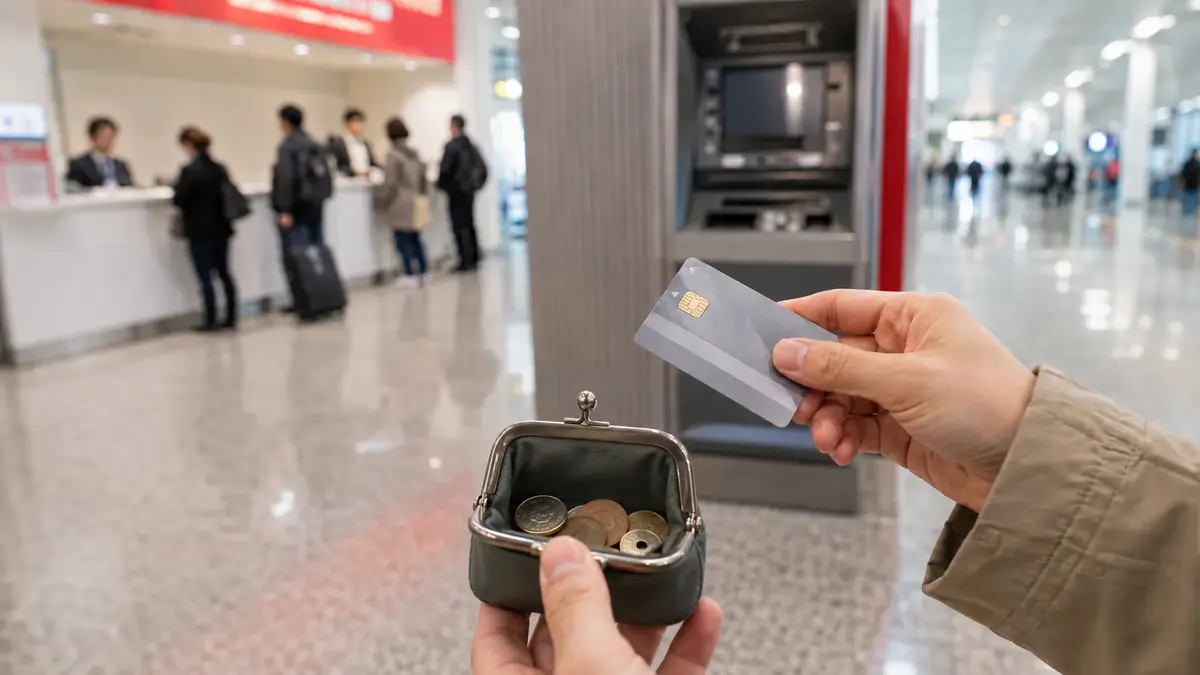
Japanese people love using coins, from denominations of 1 yen, 5 yen to 500 yen. Coins accumulated after each purchase at a convenience store will quickly fill your pocket, so you should prepare a small wallet with a separate drawer for coins for easy classification when paying.
To receive card transaction notifications, payment authentication OTP codes from Vietnamese banks or look up the map to find the nearest ATM, you need to maintain a continuous network connection. Having a Japanese eSIM package available before your trip will help you keep your Vietnamese phone number on your phone to receive authentication code messages while still having stable internet access data capacity right after landing.
Frequently asked questions
Are there many fees deducted from withdrawing money at 7-Eleven ATMs in Japan?
Withdrawal costs include foreign currency conversion fees of Vietnamese banks (usually fluctuate according to each bank's regulations) and fees for using Seven Bank's ATMs. The overall fee is usually acceptable if you withdraw in small amounts instead of withdrawing small amounts many times.
Should I convert my entire budget to yen before flying?
You should not carry your entire budget in cash for personal safety reasons and customs declaration limits. Combining a sufficient amount of cash for basic expenses and an international payment card is a safe and flexible solution.
Can Vietnam's Napas domestic ATM card withdraw money in Japan?
Most ATMs in Japan, including Seven Bank, only accept international payment brand cards such as Visa, Mastercard, JCB or UnionPay. Regular Napas domestic cards will not be able to make withdrawals here.
Closing
To optimize costs and safety, you should proactively exchange a sufficient amount of cash at domestic banks early, combine bringing an international payment card to spend at shopping centers and withdraw backup money at 7-Eleven ATMs when needed. Don't forget to prepare a smooth network connection with shibaSIM's Japan travel eSIM packages so that the process of looking up information and managing bank accounts always goes smoothly.